Sink, Ruth Ann and me: writing because we do

Sherwood Forest by night, photo by John Sinkevics

Girls just wanna have fun, boys just wanna be dumb, and writers just want to write. Better yet, they want people to read their writing.
This is what a devoted diaspora of now-freelance journalists continues to do in West Michigan. We join legions of writers nationwide set loose into the marketplace by the downsizing of the newspaper industry. Nobody’s sure whether newspapers will survive in the long run, but you can bet that writers will still write wherever and in whatever form they can.
We pin our hopes on our passion for words, the belief that someone will always want to read them – and on our faith that the writing and reading of stories can still make a difference.
Let me introduce you to two of these talented and faithful freelancers: John Sinkevics and Ruth Butler, both longtime friends, smart observers of this thing called life, and truly gifted writers.
John – better known as Sink to his friends and coworkers — is my intrepid bandmate for 26 years in our eternal garage-rock project The Honeytones, and former longtime music critic for The Grand Rapids Press/Mlive. Besides playing a mean keyboard and belting out surprisingly savage vocals on “Beds Are Burning” and “Hey Bulldog” – not to mention playing through a downpour at Festival one year and draining the rain off his keyboard — Sink is a consummate pro and skilled, insightful reporter.
Since leaving the Press earlier this year, he has maintained a music blog, Spins on Music, which you will find in my blog roll. It is an entertaining and reliable guide to the latest in the West Michigan music scene, continuing John’s faithful coverage that earned him an award at the WYCE Jammies this year. From troubadours and guitar heroes to sound guys and promoters, Sink knows local music like the back of his keyboard, and it shows in Spins on Music.
Recent entries include a piece on the regrettable closing of the Ottawa Tavern as a jazz club – when will such a thing take hold in our fair city? – and the carryings on of the Electric Forest festival in Rothbury. Aided by a smartly composed video, John helps us city slickers envision what goes on up there in the woods. To me, it looks like Tolkien’s elvish realm of Lothlorien invaded by percussion-hammering, hula-hooping hippies and light-show wizards from the Sixties Fillmore Auditorium.
It’s altogether entertaining and informative, taking me places I couldn’t get to but can experience a bit of thanks to Sink.
If Sink’s writings take him from jazz clubs to Meijer Gardens to forests where the wild things are, Ruth Butler’s musings take us from pop culture to politics to the little annoyances-slash-blessings of daily life.
Ruth Ann, as I affectionately call her, is well-known in these parts as a longtime columnist for The Press, and a TV critic for many years prior. She was also my editor on the religion beat, gently correcting my mistakes, suggesting improvements and saving me from embarrassing foolishness in print.
Ruth and I go back a long ways, including years working in the features department formerly known as Flair. There we enjoyed sparring, over our desks and occasionally in print, on issues of the day great and small. OK, mostly small, like the real reason men wear neckties (you’ll have to ask Ruth).
Ruth, like me and several others, took a voluntary buyout from The Press in 2009. She now maintains a freelance blog and smartly designed Web site, also to be found on my blogroll.
Here, in a regular Sunday column and other postings, Ruth zeroes in on issues sometimes overlooked by the major media. She recently and rightly zeroed in on Ann Romney  for her flippant comment that she loves the fact some women don’t have a choice but to work and still raise kids. Writes Ruth, “As in: I LOVE the new Coco-inspired jewelry.” Ouch!
Ruth Ann also took a well-aimed and fully deserved shot at our state legislators who silenced the Rep. Lisa Brown for using the word “vagina” in debating an anti-abortion bill. In her usual cut-to-the-chase style, Ruth wryly observed, “mentioning body parts is only offensive in places where people have the power to make laws regarding them.” Ouch again!
Whether commenting on the halls of power or the woodland playgrounds of hipsters, Ruth Ann and Sink have things to say well worth reading. As a fellow writer in the freelance wilderness, I highly recommend their words. I guarantee you’ll find them agreeable and informative company.

Posted in Uncategorized | Leave a comment

on top of the world, dreaming

As I run downhill into the great wide green park, a Tom Petty song pours through my earbuds:
I got someone who loves me tonight
I got over $1,000 in a bank, and I’m all right
Look deep in the eyes of love
And find out what you were looking for
I got a room at the top of the world tonight
And I ain’t comin’ down
My running takes me past a couple chatting by a pond, parents pushing little ones in strollers, a woman laying out picnic fixings. I’m pulled by the sights before me and the sounds playing in my head. The body obeys my will, legs pumping, lungs huffing, skin sweating. A minor miracle that I am still running after all these years. My knees should be gone by now, or my wind, or my will. But someone ran before me, showing me the way.
Running under the mighty maple and oak trees of the park, I feel sheltered by their roof of leaves and their ancient strength. I always run underneath them in an invisible path known only to me.
My iPod summons “He’s Gone Away,” a lovely instrumental by Pat Metheny and Charlie Haden, just as I am passing by a picnic table in a tree-sheltered glade. I know I must stop and sit here. This is the tune we played at my father’s memorial service as soundtrack to a slideshow of his life. My sister chose it because it was this album, “Beyond the Missouri Sky,” that gave her comfort night after night following Mom and Dad’s passing.
I first sit, then lie on the rough wooden table, looking up through the canopy of leaves at the sky above. Patches of bright blue are flecked with soft white clouds blowing by from north to south. Here, the sky speaks to my mind.
I love this sky because Dad taught me to; I adore these mighty trees because he fought forest fires as a young man; rest from my running because he circled the track every day between classes at MSU. I love listening to this song because mom played “Won’t You Come Home, Bill Bailey?” and “Moonlight on Vermont” on the baby grand piano she inherited from grandma, who played ragtime at the New Year’s Eve parties.
The sun starts to glow behind a cloud, then breaks clear into open sky, gloriously, blinking through the roof of leaves overhead. I weep because this is the heart they gave me, easily moved by the mystery of the world and the emotions welling deep inside.
All these feelings, gifts, inclinations, wonderings, came from them, to me. And all of it came from God, through Mom and Dad, through me, to my children, to all my loved ones.
Why do I say it all comes from God? Because I choose to. It is one of the few decisions over which I have any say, and I say it every day.
My iPod summons U2, and I know I must lie a moment longer.
I was speeding on the subway
Through the stations of the cross
Every eye looking every other way
Counting down till the pain will stop
At the moment of surrender
Of vision over visibility
I did not notice the passers by
And they did not notice me
The breeze dries my tears and cools my sweat. I sit up. No one passing by. It is time to run again.
So run I do. It’s what I was made for.

Posted in Uncategorized | 4 Comments

What he gave, I’ll never know

Memorial Day, 2012:
One of the few clear images I have of Dad in World War II is of him slung into a kind of hammock, reading below deck of the USS Cabot in the South Pacific. It was a secret spot of refuge for him amid the daily insanity of warfare. Reading provided him a respite from the rigors of the world, as it had since he had read Jack London, Zane Grey and Alexander Dumas as a boy.
A less romantic image is of Dad sitting on the long trench-like bench that served as a latrine on the aircraft carrier, looking straight across at a fellow serviceman on the opposite latrine who was blowing cigarette smoke into his eyes.
Dad hated war. Like many WW II veterans, he didn’t much talk about it and certainly didn’t glamorize it. He’d go into it if we asked him to, and in later years upacked more detail than we three kids had heard before. He wasn’t particularly proud of what he’d done as a radioman and tail gunner on a torpedo plane; he may, in fact, have felt a little shame about it. Dropping torpedos and depth charges to kill other people was not consistent with his character.
But Dad had signed up for the Navy gung-ho, as many did in those days. In the car on a date with Mom and their good friends Mary and John Read, he heard the radio report of the attack on Pearl Harbor. Right then, he told me years later, he knew what his future was.
Here is the account my sister, Maureen, gave in “An Album of Memories: Personal Histories from the Greatest Generation,” a compendium of letters by and about WW II vets compiled by Tom Brokaw:
“My father gave up his summers fighting fires in the national park system and interrupted his college education at Michigan State to enlist after the bombing of Pearl Harbor. He tried to join the Marines as an expression of his desire to fight, but a heart murmur kept him out, to his great disappointment. My grandfather wanted him to sign up for officers’ school when he joined the Navy, but Dad wanted to be one of the ‘grunts.’ He was 20 years old.”
That last line slays me. Dad was barely beyond boyhood when he went to battle, as have been so many, then and now, who put their lives on the line for us. No questions asked, he went to war to save the world from murderous madmen. Dad would always downplay that heroic role, but I never let him get away with it.
This day memorializes those who died in trying to protect the rest of us. Like Dad, I hate war. I believe wars are almost never necessary and usually serve ignoble ends. My brother, Mike, served his country as a conscientious objector to Vietnam, doing civil rights work in the South. I shared his objection, though I honor those who risked and lost their lives doing what they felt needed to be done for all of us.
But I believe WW II was a necessary evil. I will always feel grateful to those who waged it both at home and abroad.
Dad’s service is modestly recorded in his flight log book, marking down every sortie he made from May 1943 to September 1944 — 543.9 hours in all. There, in his remarkably neat handwriting, one sees many of the historically crucial engagements the Cabot made in the South Pacific theater: Truk, Tinian, Palau, “shelling Iwo Jima,” “found two men in raft from last nites raid.” The Cabot later received a Presidential Unit Citation, one of three light carriers so honored in World War II.
On Jan. 31, 1944, Dad wrote this entry: “CRASH LANDED IN WATER.”
Although Dad did not die in the war, he came plenty close when his plane hit the drink upon returning from a mission. Dad and his pilot survived by inflating “Mae West” flotation devices and lying on their backs to absorb the shock waves of the sinking depth charges. Dad’s crew mate, Tom Wolf, did not.
In the last year of Dad’s life, the pilot wrote him a letter confessing his guilt about Wolf’s death. Dad called him to reassure him it was not his fault, perhaps salving a wound that had festered for half a century.
There’s so much we don’t know about what our fathers went through in that war, nor our mothers. They did what they had to do. The lucky ones returned to have families and build a life for us, their children.
Most of what Dad went through in the war, as a young man flying through shrapnel and making daily sorties into hell, I never will know. Dad didn’t want me to.
Yesterday, my sister and brother and I visited Mom and Dad’s gravesite for the first time. The VFW had planted a flag next to Dad’s name. We were a little surprised, and certainly grateful, to see the miniature stars and stripes fluttering in the warm breeze next to our dear father’s name.
Other flags fluttered over other graves in Williamston’s Summit Cemetery, modest markers of the sacrifices people from this small Michigan town made for their country.
Most of what they gave, in war and at home, we will never know.

Posted in Uncategorized | 2 Comments

a button for Mother’s Day

this one's for you, Mom Dear Mom,
Today I sewed a button. I sewed it onto one of Dad’s old shirts, the short-sleeved one with blue, grey, white and red vertical stripes. I wear this shirt from time to time, not just because I like it but because it reminds me of Dad.
Anyway, one of the button-down collar buttons popped off the other day, which kind of made me pop off. Great – now I have one side of the collar buttoned but not the other! Leave it to some underpaid worker in Bangladesh to not do the best threading job.
I was actually waiting to take this over to Andrea’s house so she could sew it on, like she did on another button not too long ago. But then I realized that was extremely lazy of me. I could sew one lousy button for Pete’s sake!
Besides, you once sat down and taught me how to do this. I remember how carefully you instructed me — how to thread the needle, then slide the needle through the button, then pierce the fabric and so forth. It was a real Zen lesson in concentrated effort.
Of course, I promptly forgot this because I never followed up to do it myself. I didn’t really want to learn how to sew buttons, because then I would have to do it. I much preferred to let you do it for me, or Andrea. One of the plusses about being a male is being helpless in such things.
Mark Twain once wrote about how instinctively bad men are at sewing. He pointed out that men reliably will try to thread the needle in the exact opposite way it’s supposed to be done – the way that women do it. Unfortunately, I can’t remember what the wrong and right ways were, thus reinforcing his point exactly.
But at this point in my life I am ready to sew on buttons. It is one of the least things I can do in your memory.
After all, you taught me how to make tomato-noodle soup and fry up delicious scrambled eggs when I was just a boy. Long after that, when I was going through my divorce with Wendy and newly single, you taught me how to make tasty dressing for cole slaw. A dash of pickle juice and a little sugar were your secret ingredients, along with licking your finger until it tasted just right.
So today I resolved to sew on that button. What a mistake.
It took me a long time just to get the needle threaded, Mark Twain-style. Then it got worse. Where do you stick the needle in, exactly, to start with? And once you’ve poked it through, where should it go back in the other way? How many different ways should you criss-cross it through the four holes?
And worst of all, how do you tie it up at the end so it doesn’t just, you know, fall off?
I have to say it’s one of the hardest things I’ve tried to do in my life. And I am sure I did it all wrong. I have no doubt that the next time I wear Dad’s shirt, that button is going to fall off before the day is through. It’ll probably pop into my tomato-noodle soup or something equally dopey.
But you know, I feel good about having sewn on the button. It’s a start. And it’s a little way to honor all the things you taught me over all the years, just to make me a little more independent and capable of taking care of myself. It was one of the many ways you told me you loved me.
So that’s what I’ll remember when I next button my collar: Mom taught me this because she loved me.
I think I’ll wear that shirt tomorrow, on Mother’s Day. Why not.
I’ll keep trying to sew because I love you, Mom. It won’t be pretty, but I’ll do my best for you.

Posted in Uncategorized | 6 Comments

Rainbows and Coltrane: two of my favorite things


The man was looking up and snapping something with his cell phone. I looked up too, coming out of Family Fare with two bags full, and smiled: an exquisite rainbow.
It was remarkably distinct, fully spanning the eastern sky from north to south. Others were looking up now as I walked toward the car. It could have been a spaceship landing, the way they were craning their necks. I snapped a couple of my own, knowing how inadequately the pictures would represent this everyday miracle.
Suddenly everything seemed extra vivid, quickened, almost cinematic. I got in the car and punched on the radio. WGVU-FM was playing a jazz-jam version of “My Favorite Things” by John Coltrane, with McCoy Tyner on piano. They turned the tune into a meandering journey as I turned left onto Lake Michigan Drive, the lyrics faintly echoing from my childhood memory:
Raindrops on roses and whiskers on kittens/ Bright copper kettles and warm woolen mittens/ Brown paper packages tied up with strings/ These are a few of my favorite things…


Driving east, I was headed straight toward the magnificent rainbow. It looked like I could drive right under it, as if it were the St. Louis Gateway Arch. Maybe I could. I kept driving toward downtown, driven by the tumbling Coltrane jam, pulled by the splendid prism.
In the book of Genesis, God sets a rainbow in the clouds as a covenant between himself and Noah, all his descendants and the earth for all time. No more floods destroying everything, ever again. “Whenever the rainbow appears in the clouds, I will see it and remember the everlasting covenant,” God tells Noah.
So, we like rainbows. They impart hope, beauty, wonder. You never know when they’ll come, and when they do they remind you how beautiful the world is. Born out of the blue quite suddenly, and then gone. They are one of the few things that still make us gasp with delight.
One of our favorite things: God splashing a paint brush across the sky.
I kept pursuing the perfect arch, straight east now, the J.W. Marriott breaking the skyline right in front of me. Coltrane’s sax played crazily like a man running up and down hills. The rainbow was almost straight overhead, but it was fading into the clouds. Its northern arc glimmered a moment longer, then it too was gone.
I turned around and drove home, at peace. I had glimpsed glory for all of 10 minutes. That’s more than you can ask for, most days.

Posted in Uncategorized | 8 Comments

Walking that lonesome valley, with flowers


Lately some very old songs have been making their way into my head, seemingly emerging from deep memories stirred by recurring thoughts of my late parents. One of them is “You’ve Got to Walk That Lonesome Valley,” an American gospel folk song of unknown origin. It’s one of those tunes I heard a lot in childhood, like “Michael Row the Boat Ashore” and “I’ve Been Working on the Railroad” (which I always think of as “someone’s in the kitchen with Dinah,” conjuring an image of Dinah Shore). I associate these songs with campfires and Sunday School — apparently a powerful combination for a tender mind.
Countless people have sung “Lonesome Valley,” including Pete Seeger, Woody Guthrie and Elvis Presley at his 1956 Sun sessions. Here is a lovely, lilting version by Mississippi John Hurt, the legendary blues singer who I am sure had to walk the valley more than once:
“You got to walk that lonesome valley
Well you got to walk it for yourself
Ain’t nobody else can walk it for you
You got to walk that valley by yourself …”
His mother also had to walk that valley, Hurt sings, as well as his father and Jesus himself. Everyone’s got to walk it at some point.
I went out to walk through it this morning. Memories of Mom and Dad were hanging around my mind like house guests whom I wanted to stay awhile longer. I wasn’t humming the tune as I went out. I was just trying to walk off the ache of loss on a fine spring morning before getting down to the business of the day.
And what a morning: cool air, bright sun and trees bursting with flowers throughout my neighorhood. But deep as I was into the valley, I didn’t pay too much attention to my surroundings until up the alley walked my old friend Carolyn, tugged along by her formidable chow-mix dogs, Zeke and Zeb. It was good to see her familiar face and hear her warm consololations. Having lost her dear father some years ago, she knows the lonely walk too well.
Only after our brief chat did I take proper notice of the beauty around me, my senses awakened by human connection. In an instant I realized that drinking in this beauty was exactly what my folks would want me to do on this day. Walk glumly with a downcast mind on a day like this? Shape up, son! As the great minister Duncan Littlefair so often declared, this is the day the Lord has made, so for Pete’s sake rejoice and be glad in it!
And so I did, snapping a few photos for good measure, a scrapbook of a beautiful day for future reference. I was still walking the valley by myself, but it did not feel nearly as lonesome as it had just minutes before.

Posted in Uncategorized | 4 Comments

Rocking with the Honeytones!

Jamming with Tommy at the Goon Lagoon.,

Recently checked into the studio with my longtime bandmate and West Michigan music critic John Sinkevics to record a theme song for his talk show, “Local Spins Live,” on 1340 AM. All props for the expert vintage recording to Tommy Schichtel and his Goon Lagoon studio for making us sound like the Ventures meet the Electric Prunes. Give us a listen here — your life will never be the same!

Posted in Uncategorized | 1 Comment

and my Oscar goes to … Vera Farmiga

Vera Farmiga sings praises in "Higher Ground"

For all the abuse it takes from critics, the Academy Awards serves at least one useful function: It makes us go to the movies. We rush during this final week to see the best-picture nominees so we can feel some ownership of the winner-selection come Oscar night.
Thanks to this last-minute cramming, my vote goes to “Hugo,” Martin Scorsese’s marvelous, magical story of a boy who lives in a 1930s Paris train station. I know — why should we care? Because “Hugo” does what wonderful movies do: It takes you someplace else, tells you a good story, fills your soul with delight and your eyes with gorgeous imagery.
As critic David Edelstein put it, “You must heed the subliminal advertising in the title. YOU GO.”
But I would offer the same advice about another 2011 film that is notably not up for an Oscar. Unlike the 3-D, big-screen marvels of “Hugo,” this is one of those “little films” that you didn’t even know was in the theaters. More to the point of this blog, it is that true Hollywood rarity – a film about faith that takes faith seriously.
More to the particular point, “Higher Ground” is about the struggle to hold onto faith and whether the fight is worth waging. Directed by and starring Vera Farmiga, this is a movie that tells its story not with dazzling images but with memorable moments. It doesn’t knock your eyes out, but sits you down and keeps your full attention in the quietest of ways.
In blogging that Farmiga was robbed of an Oscar nomination, critic Roger Ebert wrote of her film, “In a world where believers and agnostics are polarized and hold simplified ideas about each other, it takes a step back and sees faith as a series of choices that should be freely made.”
My soulmate Andrea and I saw “Higher Ground” in the theater of Netflix, where so many fine little movies await our watching. We took a chance because we like Farmiga, who has quietly worked her way into the public eye with excellent performances such as George Clooney’s lover in “Up in the Air.” Farmiga has a natural, winning way about her that makes you wait for her presence onscreen.
In her directing debut here, she won critics’ praise with her portrayal of a woman living in an evangelical religious sect who finds herself increasingly conflicted about both its doctrinal demands and her feelings for her onetime rock-musician husband.
Typically, this would be a setup for one brave woman’s escape from an oppressive, narrow-minded cult. Not so here. Farmiga portrays the beliefs and people of her faith community with rare sensitivity and respect. Her non-judgmental lens shows us real people trying to live out their faith, not cardboard action figures representing naive believers.
In this it recalls “The Apostle,” Robert Duvall’s excellent 1997 film about a Pentecostal preacher on the run from a horrible crime. That movie, like “Higher Ground,” is the rare film that “respects the authenticity of religious experience,” as The New York Times’ A.O. Scott put it.
Too often Hollywood goes to one extreme or the other with faith, portraying preachers as hypocritical buffoons and their followers as gullible goats — or praising the faithful as brave and perfect pilgrims in a shallow and hateful world. If it’s a movie about biblical figures, even in such largely well-done films as “The Nativity Story,” its main characters can do no wrong because, well, because the Bible said so.
But in faith, as in all else, the story is seldom simple. Movies like “Higher Ground” respect faith by treating it as a complex, living reality.
In Farmiga’s case, the nuances she gracefully captures no doubt spring from her own experience growing up in a Ukrainian Orthodox family that converted to Pentecostalism. Her story reflects the reality that you can love people of faith, even envy them, without being able to believe with them.
It’s the kind of story Hollywood should lift up more often. Since the Academy hasn’t, let me do it for you. I would offer the same advice as for “Hugo”: You go.

Posted in Uncategorized | Leave a comment

if I had it to do all over again, I wouldn’t

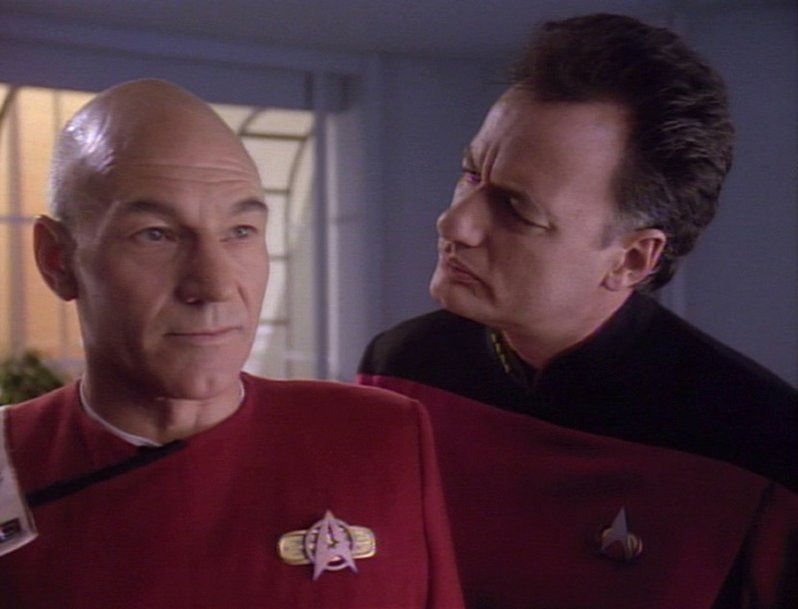
Picard and the infamous Q

One of the great virtues of the “Star Trek” enterprise was the optimistic outlook of its creator, Gene Roddenberry. The shows reflected his basic faith that the human endeavor was ultimately worthwhile, and that it was possible for the human race to become more humane and enlightened as it evolved. The future could be better.
This fundamental optmism about the human condition was well-expressed in one particularly memorable episode of “Star Trek: The Next Generation.” The episode, titled “Tapestry,” aired during the show’s sixth season in 1993.
It involved the infamous Q, an occasional character with god-like powers who exercised them with Loki-like mischievousness, although he seemed to have a sympathetic heart somewhere deep down. He was played by John de Lancie, the son of a renowned oboist who found the role of his acting career in this annoying yet likable character.
The episode centers around a bar fight waged during the youth of Captain Jean-Luc Picard, in which he came to the aid of a fellow cadet set upon by ugly alien bullies called Nausicaans. In defending his comrade Picard is stabbed in the heart. When his artificial heart is damaged years later, he awakens in what Q tells him is the afterlife – a fate he would not have suffered if he had his original heart.
Q gives Picard the chance to do over the bar brawl and thus avoid death. When thrown back in time, the captain stays out of the fight much to the disgust of his friend. Picard avoids the stabbing, but then finds he lives out his career as a mid-level functionary – a paper-pusher who never rises to the level of captain nor to the respect of his fellow Enterprise crew members.
Appalled by the consequences of playing it safe, Picard asks for yet another shot at the bar. Q gives it to him, Picard gives the Nausicaans what they deserve, and the captain awakes laughing on the operating table – saved physically by Dr. Crusher and morally by Q’s machinations.
Picard’s epiphany: “There are many parts of my youth that I’m not proud of. There were… loose threads – untidy parts of me that I would like to remove. But when I pulled on one of those threads – it’d unravel the tapestry of my life.”
I am not a Trekkie and have never attended a convention outfitted with pointy ears. But I have often recalled this episode in dealing with events from the past. Often I wish I had done things differently, done them better or not done them at all.
This wishing quickly evokes regret, which is a natural but mostly useless emotion – a longing to change things that cannot be changed. This kind of wishing fits the Buddhist definition of suffering. It is a desire that cannot be fulfilled, a pain that cannot be removed.
The little lesson that Roddenberry offers in this episode is this: You probably did the best you could with what you knew at the time. If you could go back and change it, the outcome of that event would be different but you might not like the ensuing consequences.
In other words, don’t waste your time wishing you could redo or undo things you regret. Learn from them, yes, but stop flagellating yourself. In this case the obnoxiously prevalent catch-phrase really does pertain: It is what it is. Accept that with a measure of peace, or burn up untold hours of sleep regretting it.
Does this mean everything happens for a reason, or God has a plan for our lives? Hmm. I don’t think “Star Trek” can help with those answers. Roddenberry was reportedly an agnostic whose ashes were buried in outer space. I assume they are still out there, going where no man has gone before.


Posted in Uncategorized | Leave a comment

skiing toward the light

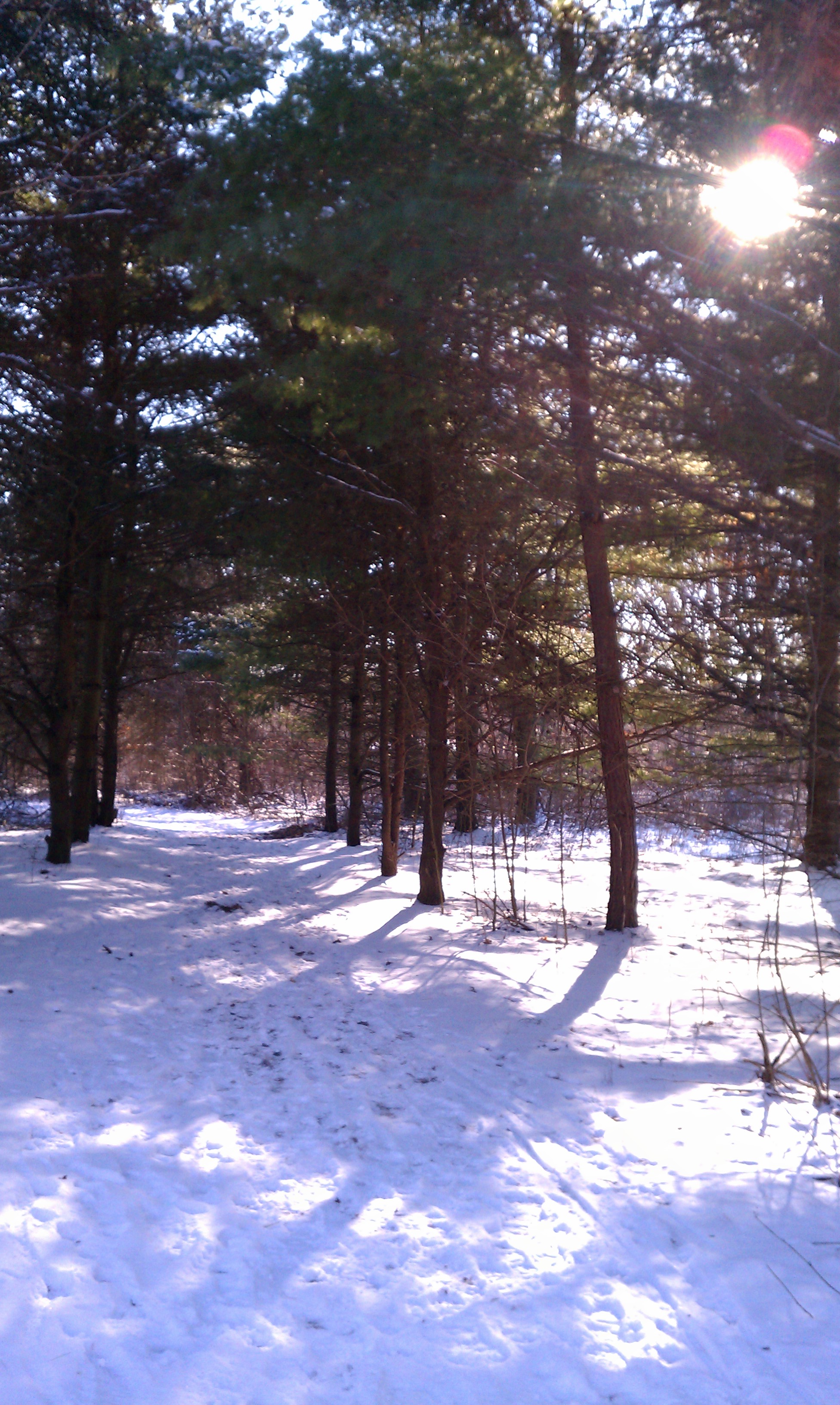
Blandford Nature Center woods

I stopped my skiing in the tunnel of pines, my own private entrance to Narnia, and looked around as I always do. The late afternoon-sun blinked through the boughs. Far-away sounds mingled with the nearer chirps of birds. I closed my eyes and drank it in like a prayer.
All this, Dad taught me to love, I thought.
It was on all those weekends at the cabin on the Muskegon River, and before that, weekends at Uncle Bub’s cabin near Grayling, that Dad taught me the beauty of trees whooshing in the wind and rivers running swiftly by. It was in nature that I first felt the near presence of God. And it was in nature, now, that I felt Dad’s presence as surely as his strong hand on my shoulder.
Here at Blandford Nature Center, my favorite quick getaway to the wild in the middle of the busy city, I knew Dad’s spirit was with me even though his body had left this life two weeks before. He had assured me beforehand that he was not afraid. So I have tried not to be afraid since then.
I felt no fear this Saturday afternoon, when the sky was bright blue and the snow unsullied white. I had taken out the skis knowing this might be my one chance this on-and-off winter.
Dad and I used to go cross-country skiing at little getaways up north. This was a way to honor him as well as let myself breathe.
A little farther on the nature center’s gentle trails, I realized something more. For all the years of my adult life, I had spent much more time away from Dad than with him. Yes, I always had the ability to call him up or drive an hour to visit him, and the loss of that is huge.
But for the most part, when I was with Dad, it was his spirit, not his physical presence, that was with me. Just as his spirit was with me now, on the Blandford ski trail, just as strongly as it had ever been.
And in that sense, Dad is just as alive to me now as he ever was.
In fact, it’s the spiritual essence of people that abides with us most of the time. The things they have taught us, the memory of good moments and the anticipation of more is how they are present to us when we are not with them — which is usually far more than when we are.
Thinking of Dad in this way made me think of one particular ski getaway we shared back in 2001. I treasure that weekend as much for what it taught me about people as for its precious memories of Dad and me. I’ll share it here in the form of a column I wrote then for The Grand Rapids Press:
MANISTEE NATIONAL FOREST, AWAY FROM PEOPLE — We were skiing through the woods, my dad and I, with that lovely shoosh sound cross-country skis make on new snow. That and my breathing were all I heard until I came to a stop and listened to … nothing.
Maybe the muffled roar of a far-off snowmobile or a dog’s lonely bark. A few bird chirps. Stubborn wrinkled oak leaves stirring in the wind. Mostly, blessed quiet.
This is how Dad and I wanted it. Just us, out in the woods, with few other people around. We do this once a year, go up to a swell little cabin near the little burg of Wellston and cruise the groomed trails of the “Big M” ski area. It’s a chance to commune with nature, reconnect with each other and live like slobs for a weekend.
Oh, we like running into the odd person here and there. This past weekend, in the Big M warming hut, we ran into a guy who my father had as a student at Michigan State University 25 years ago, and who used to work with one of my best friends. People like him we were delighted to meet.
Otherwise, the fewer people the better. We didn’t really need them for our getaway experience. Just us and the snow were good enough.
In the glide zone
As I shooshed through the woods, I found myself slipping in and out of the glide zone — the mental terrain where I was focused on the moment, the soft pine boughs and woodpecker-ravaged stumps and good cold air.
Out of the glide zone, I thought about stories I was working on, kid problems, what I wanted for dinner. Ski while you’re skiing, I reminded myself. Later, you can eat while you’re eating.
It wasn’t long before we got to that eating part and spun out of the glide zone like a Pinto on black ice.
We’d driven into Manistee for dinner when a woman pulled alongside our Ford Explorer. “You’ve got a flat tire!” she yelled, pointing at the wheel. We’ll call her Good Samaritan No. 1.
We pulled into a parking lot and had a look. “Yep, she’s flat all right,” we said, speaking from years of manly experience. Nothing we couldn’t handle. We got out the spare and the jack and went to work. I grabbed the tire iron and started loosening lug nuts. One, two, three … hmm, this baby’s a toughie. Maybe if I put my shoulder into it and give ‘er a real good yank —
(I can just hear all the grease monkeys yelling, “DON’T DO IT!!”)
Yank! Oops. That lug nut looked like a piece of crushed tin foil. Time to call AAA.
Good Samaritan No. 2, a clerk at a nearby store, helped Dad make the call. Meanwhile, Samaritans 3 and 4 stopped by and asked if they could help.
Samaritans 5 and 6 pulled up in their tow truck and, after a few valiant turns, declared the crushed lug nut unloosenable. “Only thing we can do is take you to a tire store and they can fix it for you Monday morning,” they said.
God help us
Talk about a day going south fast. It’s 5 p.m. Saturday, an icy breeze is blowing and we’re 15 miles from our cabin. I’m focused on the present now, baby: How do we get back out there? How do we get back into town Monday morning? And what the heck are we gonna eat?
“There is no spot where God is not,” my grandma used to say, and I always believed her. Just across the street was a bus with its engine running. Dial-a-ride, the towing guys called it. It’s actually called Manistee County Transportation, the most wonderful public transport system in the world.
I walked over and asked if they could help us out. Driver Dave Hoffrichter, who was just about to get off work and take his wife to dinner, said no problem. He hauled us back out to our cabin in the woods, telling us about how he takes senior citizens shopping and high school kids skiing. For our $2 fare, he worked an hour overtime. Definitely Good Samaritan No. 7.
Add Joy Bass, the woman whose cabin we rented, as a big No. 8. Take my van to breakfast and dinner Sunday, back into town Monday and anywhere else you need to go, she said, throwing in two cans of soup and a loaf of bread.
On Monday morning, tire shop owner Phil Ludwigson (No. 9) took that crummy lug off and fixed our flat for a measly 12 bucks.
So Dad and I got an extra day to re-connect, ski and loaf, thanks to our newfound friends. Suddenly, we were darn glad to have people around.

Posted in Uncategorized | 4 Comments